
15 Thoughtful New Year Reflection Questions for a Transformative 2026

As we wrap up 2025 and step into 2026, I’ve always believed there’s real power in pausing for a new year reflection by looking back honestly. For me, it’s often over a quiet evening with a notebook, reflecting on what went well and what didn’t—without rushing to “fix” everything. It’s a gentle way to honor the year that’s passing and open up to what’s ahead.
This kind of reflection isn’t new; psychologist James Pennebaker‘s research at the University of Texas has long shown how writing about our experiences—especially the emotional ones—can lower stress and even support better health. His expressive writing studies highlight how just a few sessions of honest writing lead to lasting benefits, like clearer thinking and emotional resilience.
I’ve pulled together these 15 questions from my own routine over the years, inspired by Pennebaker’s work and common end-of-year practices that emphasize gratitude, release, and intention-setting. They’re grouped into three parts for easier flow: reviewing 2025, letting go of what weighs you down, and envisioning 2026.
Find a calm spot, maybe with tea or a candle, and write whatever comes—no need for perfect sentences.

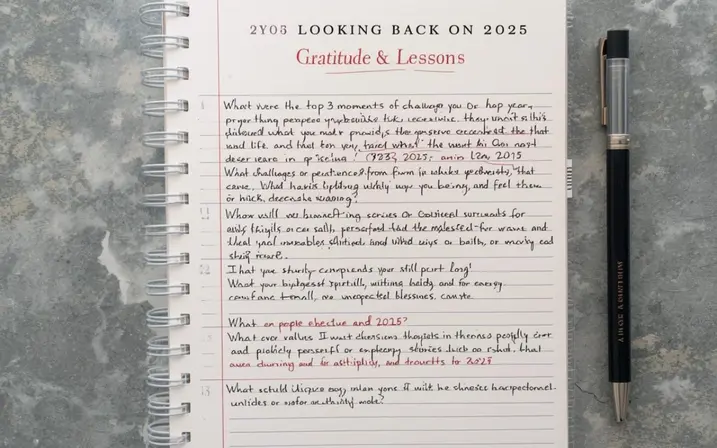
Reflecting on 2025: Honoring Wins and Growth
- What were the three moments from 2025 that left you feeling truly proud or alive?
- Which difficulties this year revealed unexpected strengths in you?
- What shifts in your outlook surprised you over the past months?
- Who added real support or happiness to your days, and how did that feel?
- If one word captured your 2025, what would it be—and what makes it fit?
Releasing What No Longer Fits: Creating Space
- What patterns, self-doubts, or expectations from 2025 feel ready to leave behind?
- Where can you offer yourself forgiveness for any lingering “should haves”?
- What consistently drained you this year, and what small boundaries could help next?
Setting Intentions for 2026: Moving Forward with Purpose
- How do you most want to feel on an average day in 2026—perhaps grounded, joyful, or at ease?
- Which part of your life (well-being, connections, personal pursuits) calls for more attention?
- Picture your fulfilling 2026: What stands out as meaningful?
- What guiding values—like growth, compassion, or balance—will shape your choices?
- What’s one gentle step you can take soon to move toward a larger hope?
- What fresh possibilities are you ready to welcome?
- Write a brief message to your end-of-2026 self: What do you hope they’re appreciating?
These questions can shift the focus from rigid goals to something more sustainable. If anxiety creeps in during reflection, a simple grounding approach like the 3-3-3 technique helps: Name three things you see, three sounds you hear, and move three body parts (like wiggling fingers or rolling shoulders). It’s a quick way to recenter, backed by mindfulness practices.
On manifestation, some turn to the 3-3-3 rule (or 3x3x3 method): Write a positive affirmation of your intention 33 times daily for three days, feeling it as already true. It’s a focused repetition exercise that builds belief.
As for journaling styles, three approachable ones stand out: gratitude (listing appreciations), stream-of-consciousness (free-flow writing), and reflective (like these questions). Each supports self-awareness in its own way.
If you’d like an easy, private space to try these, DailyVent Journal lets you write freely—mood-based options, local browser storage only, no accounts.
Wishing you a 2026 full of clarity and kindness toward yourself. You’ve earned it.
FAQs
What is the 3-3-3 technique?
A grounding method for anxiety: Name 3 things you see, 3 sounds you hear, and move 3 body parts to shift focus to the present.
What is the 3-3-3 rule for manifestation?
Often called 33×3: Write your intention as an affirmation 33 times a day for 3 days to reinforce it subconsciously.
What are the three methods of journaling?
Common ones include gratitude journaling (focusing on thanks), reflective journaling (deep questions like these), and stream-of-consciousness (unstructured free writing).
What is the 3-3-3 strategy?
It can refer to productivity (3 hours deep work, 3 urgent tasks, 3 maintenance activities) or the anxiety grounding technique above.
Please try journaling prompts to have real reflective moments as you bid adieu to 2025.
Way cool! Some very valid points! I appreciate you penning this
post and the rest of the website is also really good.